Introduction
A Project Management Plan is one of the most important governance documents in any large organisation. It sets the framework for how a project will be planned, executed, controlled, communicated, governed, and delivered. Whether the organisation operates in IT, engineering, construction, financial services, healthcare, manufacturing, energy, retail, or public sector environments, the Project Management Plan defines standards, behaviours, responsibilities, and expectations for all stakeholders.
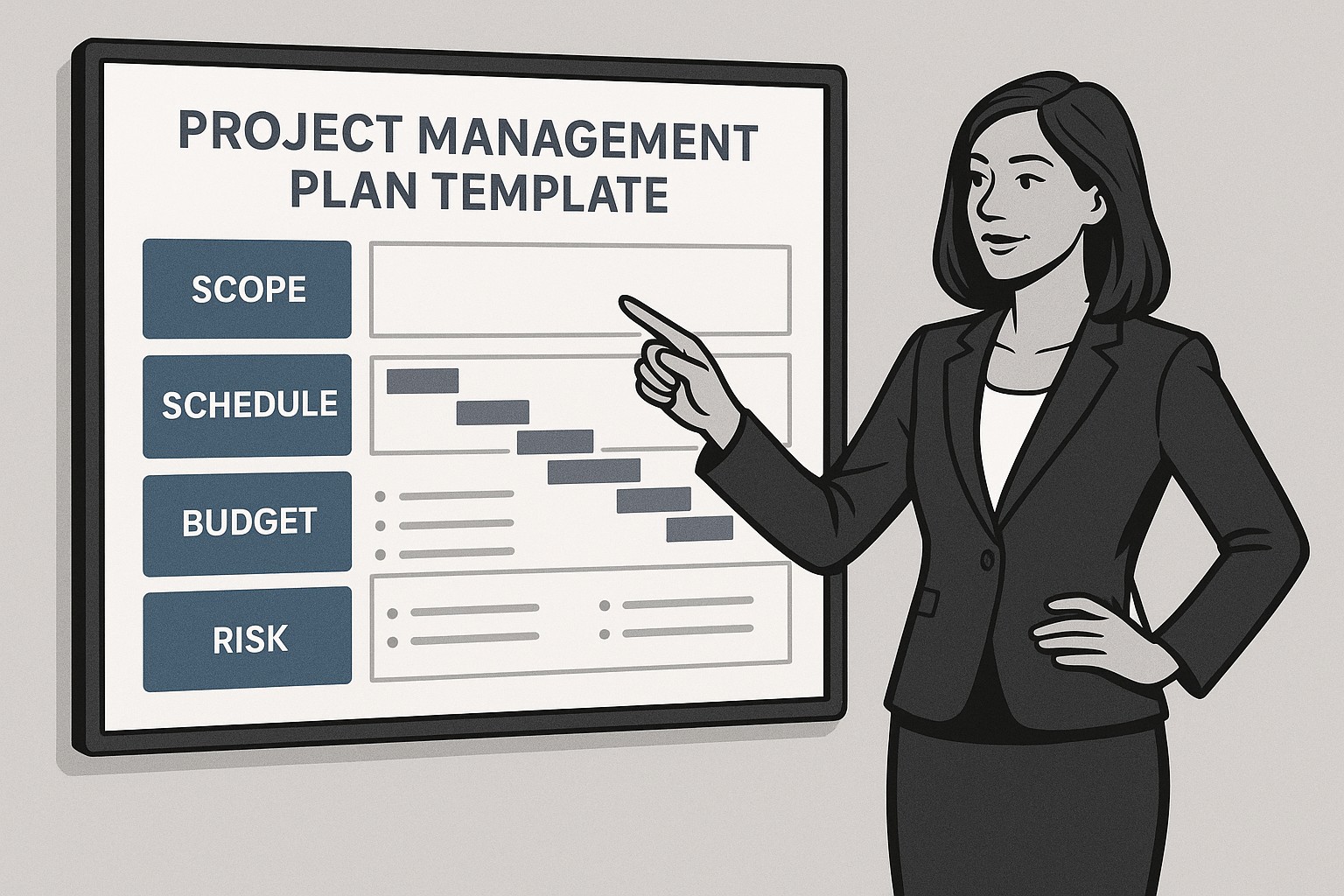
A high quality Project Management Plan template enables consistent delivery, reduces project risk, accelerates mobilisation, strengthens governance, and ensures alignment with organisational strategy. It becomes the central reference point for project teams, executives, vendors, and PMOs throughout the entire lifecycle. This blog provides an enterprise scale Project Management Plan template, complete with structured headings, tables, examples, actionable insights, and guidance tailored for complex corporate environments.

This template can be copied directly into Word or Google Docs, expanded for complex programmes, or simplified for smaller initiatives. It is suitable for waterfall, agile, or hybrid delivery, and aligns to the needs of project sponsors, PMOs, governance boards, and senior leadership teams.
Project Management Plan Template (Enterprise-Ready)
Below is a comprehensive template designed specifically for large organisations.
Project Overview
Purpose of the Project
State why the project exists, what strategic value it provides, and how it supports organisational goals.
Project Background
Summarise the business drivers, opportunities, compliance requirements, technology goals, or operational challenges that led to project initiation.
Project Objectives
List measurable objectives covering cost, timeline, scope, customer value, risk reduction, compliance, or performance improvement.
Success Criteria
Define success indicators used by executives and governance boards to determine project achievement.
Scope Definition
In Scope
Describe all features, deliverables, departments, systems, processes, and technologies included.
Out of Scope
Clarify exclusions to manage stakeholder expectations and reduce scope creep.
Table: Scope Summary Example
| Category | In Scope | Out of Scope |
| Technology | CRM configuration, data migration | ERP redesign |
| Processes | Sales workflows, service cases | Supply chain processes |
| Regions | UK, EU | APAC |
Governance and Roles
Governance Model
Explain the project governance structure including boards, escalation pathways, and review cadence.
Key Roles and Responsibilities
Define the responsibilities of project manager, sponsor, PMO, technical leads, business leads, risk manager, and vendor partners.
RACI Matrix Example
| Task | PM | Sponsor | IT Lead | Business Lead | PMO |
| Approve Business Case | C | A | C | C | I |
| Define Requirements | R | I | C | A | I |
| Vendor Management | R | C | A | C | I |
(R Responsible, A Accountable, C Consulted, I Informed)
Project Approach
Delivery Method
State whether the project uses waterfall, agile, or hybrid methodology and justify its suitability.
Phase Overview
Provide a high level breakdown of planning, design, build, test, deploy, and hypercare phases.
Workstream Structure
Identify cross functional workstreams such as data, technology, business, process, change, testing, and operations.
Schedule and Milestones
High Level Timeline
Provide a summary of key phases, deadlines, and dependencies.
Milestones Table Example
| Milestone | Date | Owner | Status |
| Requirements Complete | 15 May | Business Lead | Green |
| Build Complete | 12 July | IT Lead | Amber |
| UAT Complete | 30 August | Testing Lead | Green |
| Go Live | 15 September | PM | Pending |
Budget and Financial Management
Budget Summary
Outline total approved funding including capital, operating, contingency, and vendor costs.
Financial Governance
Explain how spend is tracked, who approves expenditure, and how forecasts are updated.
Example Budget Table
| Category | Budget | Forecast | Actuals |
| Technology | £1.2m | £1.25m | £600k |
| Vendor Costs | £800k | £820k | £350k |
| Internal Staff | £400k | £390k | £200k |
| Contingency | £150k | £150k | £0 |
Risk, Assumptions, Issues, and Dependencies (RAID)
Risk Management Approach
Explain how risks are identified, escalated, mitigated, and reviewed.
RAID Log Example
| Type | Description | Owner | Impact | Mitigation |
| Risk | Data quality may delay migration | Data Lead | High | Data cleansing plan |
| Issue | Vendor environment unstable | Vendor | Medium | Weekly environment review |
| Dependency | API team must finish integration | IT | High | Dependency tracking dashboard |
Stakeholder Engagement and Communications
Stakeholder Map
Identify executives, users, partners, and impacted departments.
Communication Strategy
Define how information will be shared and which channels will be used.
Communications Table Example
| Audience | Frequency | Channel | Owner |
| Steering Board | Monthly | Slide deck | PM |
| PMO | Weekly | Report | PM |
| Users | Pre Go Live | Email, training | Change Lead |
Quality Management
Quality Standards
Define the organisational standards, testing policies, and assurance criteria.
Testing Strategy
Summarise unit testing, system testing, integration testing, user acceptance testing, regression testing, and cutover validation.
Quality Metrics
List defect thresholds, acceptance criteria, control gates, and compliance checks.
Change Management and Training
Change Approach
Explain how user readiness, communication, and adoption will be managed.
Training Plan
Identify training tools, sessions, materials, and support structures.
Adoption Metrics
List KPIs such as user login rates, workflow completion, process compliance, and satisfaction scores.
Procurement and Vendor Management
Vendor Responsibilities
Outline deliverables, SLAs, acceptance criteria, and contractual obligations.
Commercial Governance
Define invoice approval process, change requests, commercial risk controls, and performance reviews.
Compliance, Security, and Data Requirements
Regulatory Requirements
List industry specific regulations such as FCA, GDPR, HIPAA, ISO standards, or energy sector mandates.
Data Protection
Describe data classification, retention, encryption, and storage policies.
Security Controls
Outline authentication, access management, audit logs, penetration testing, and vulnerability management.
Reporting and PMO Alignment
Reporting Cadence
Weekly reports, monthly steering comms, dashboards, and portfolio updates.
PMO Integration
Explain how project data, metrics, and controls align with enterprise PMO governance.
Cutover and Go Live Plan
Readiness Checklist
Define exit criteria, approvals, testing sign off, and operational readiness requirements.
Cutover Steps
Document the sequence of activities required for cutover.
Hypercare
Provide support model, triage process, stabilisation period, and performance monitoring.
Project Closure
Completion Criteria
State all criteria for closure including deliverable acceptance, financial closeout, and documentation.
Lessons Learned
Conduct a structured retrospective and document insights.
Handover to Operations
Ensure BAU teams receive full documentation, training, and ownership.
Conclusion
A Project Management Plan is essential for achieving consistent, controlled, and predictable project delivery across large enterprises. It defines how the project will operate, governs stakeholder expectations, and ensures alignment with organisational strategy. By using a structured template, organisations reduce risks, improve coordination, strengthen governance, and accelerate mobilisation. The template in this blog can be adapted for complex multi year programmes, technology transformation, construction initiatives, business change, regulatory compliance projects, and operational improvement efforts.
Hashtags
#ProjectManagement #PMOTools #EnterpriseDelivery #Governance #Templates
External Source
Explore additional enterprise project planning resources at:
https://www.smartsheet.com/project-management-templates
Leave a Reply