Introduction
Large organisations rely on structured governance to manage the risks, complexities, and interdependencies that shape modern programmes and projects. Whether delivering digital transformation, regulatory compliance, infrastructure upgrades, product launches, mergers and acquisitions, or enterprise system implementations, leaders must ensure risks, assumptions, issues, and dependencies are identified, controlled, and monitored consistently.
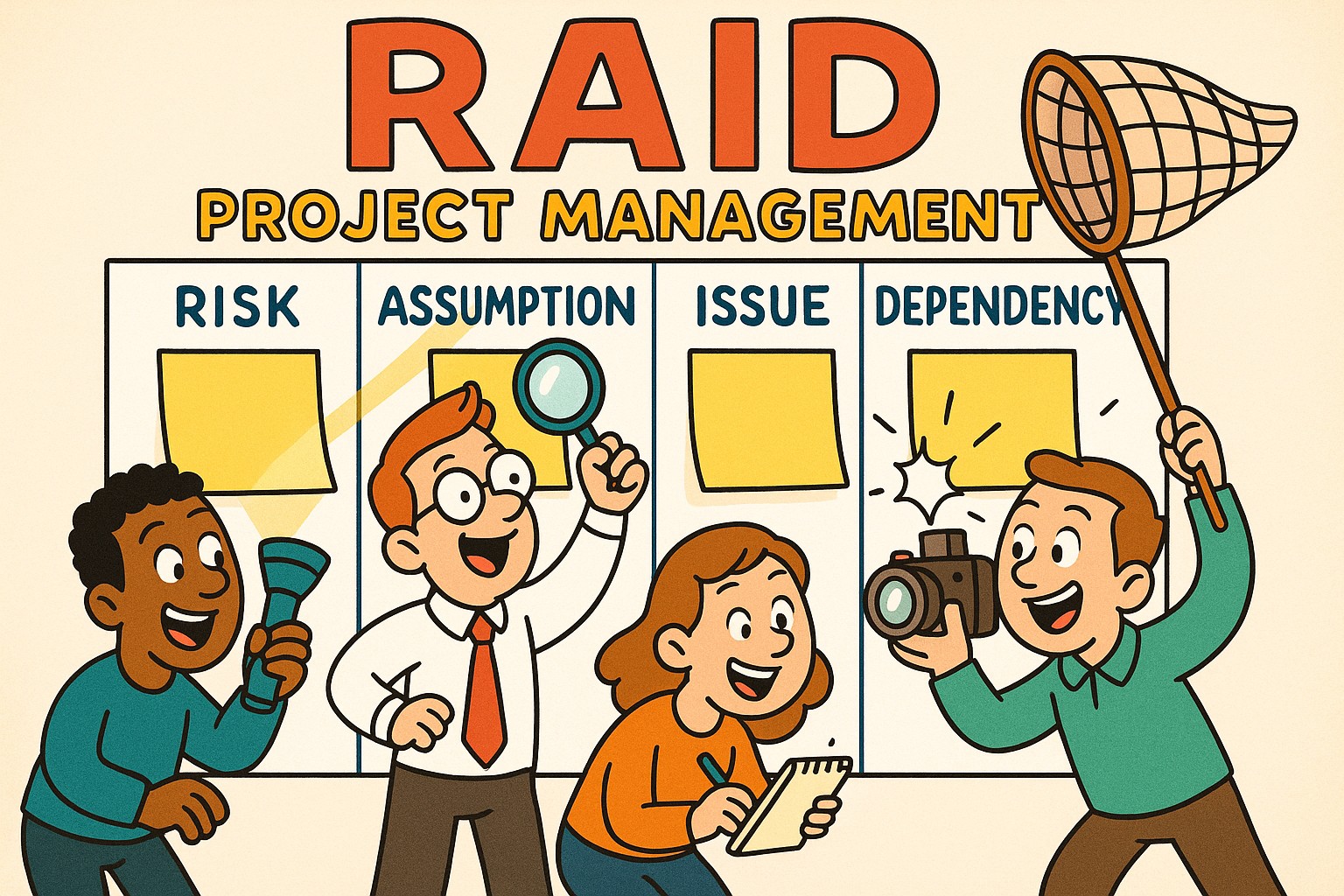
RAID project management provides the foundation for this discipline. RAID stands for Risks, Assumptions, Issues, and Dependencies. It is a core project governance tool used across global corporates, PMOs, transformation offices, and large delivery teams to strengthen decision making, enhance transparency, and improve delivery performance.
This blog provides an enterprise scale perspective on RAID management, explaining each component in detail, how to implement RAID governance, industry examples, actionable insights, practical templates, and best practices that align with the needs of complex organisations.

Why RAID Management Matters in Large Organisations
Enterprise projects operate under complex conditions. They involve multiple departments, technical systems, regulatory frameworks, suppliers, and customer groups. Without RAID discipline, organisations face:
- Escalating risks
- Missed deadlines
- Budget overruns
- Uncontrolled project drift
- Poor decision making
- Inconsistent communication
- Governance failures
- Undetected dependencies
RAID provides a structured mechanism to identify, document, track, communicate, and resolve delivery threats before they escalate.
Breaking Down RAID: Enterprise Definitions
Risks
Events that may occur in the future and impact delivery, cost, scope, quality, compliance, or customer outcomes.
Enterprise Risk Examples
- Data migration failures
- Regulatory non compliance
- Vendor delays
- Resourcing shortages
- Technology integration failures
- Cybersecurity vulnerabilities
- Stakeholder resistance
Assumptions
Factors believed to be true that influence planning, cost, timeline, or scope. If assumptions change, project conditions change.
Enterprise Assumption Examples
- Stakeholder availability
- Vendor capacity
- Funding approval
- System environments being stable
- Business readiness milestones
Issues
Events that are already happening and impacting the project. Issues require immediate attention.
Enterprise Issue Examples
- Defect volumes too high in UAT
- Key SME unavailable
- Vendor missing contractual deadlines
- Outdated documentation
- Capacity shortages across business teams
Dependencies
External or internal tasks, decisions, or activities that must occur for the project to progress.
Enterprise Dependency Examples
- API development from another team
- Approval from architecture or security
- Data extracts from finance
- Vendor delivery milestones
- Third party integration readiness
How RAID Strengthens Enterprise Governance
RAID management provides a structured mechanism for oversight, decision making, and risk control across large and complex programmes.
1. Transparency
Executives and PMOs gain visibility into delivery threats, bottlenecks, and blockers.
2. Consistency
Every project applies the same structured approach, improving quality and predictability.
3. Escalation Discipline
Issues and risks are escalated through governance boards with clear ownership and mitigation.
4. Decision Support
RAID insights guide prioritisation, investment decisions, resource allocation, and contingency planning.
5. Accountability
Clear ownership drives responsibility and timely action.
Enterprise RAID Log Template
Below is a comprehensive RAID log format suitable for all industries.
RAID Log Table (Enterprise Format)
| Type | Description | Impact | Likelihood | Owner | Mitigation / Action | Target Date | Status |
| Risk | Data migration may exceed timelines | High | Medium | Data Lead | Add cleansing resources, run early tests | 10 Jul | Amber |
| Issue | Integration environment unstable | Medium | High | IT Lead | Technical fix, vendor escalation | 4 May | Red |
| Assumption | SME availability confirmed | Low | Low | Business Lead | Validate availability weekly | 20 Apr | Green |
| Dependency | Architecture approval required | Medium | Medium | Architecture | Submit documentation for review | 12 May | Amber |
How to Implement RAID Management in Large Organisations
1. Establish a RAID Framework
Governance teams and PMOs must define:
- RAID categories
- Templates
- Severity scoring
- Ownership models
- Escalation routes
- Review cadence
2. Train Project Teams
Training ensures consistent use of logs, clear writing quality, accurate impact assessment, and appropriate escalation.
3. Integrate RAID Into Project Ceremonies
RAID should feature in:
- Weekly team meetings
- Steering boards
- PMO reviews
- Release planning sessions
- Programme sync calls
4. Use Centralised Tools
Hive, Jira, Asana, Planview, Monday.com, SharePoint, and Smartsheet are commonly used RAID management systems in enterprises.
5. Maintain RAID Quality
Large organisations often struggle with outdated RAID logs. PMOs should ensure:
- Regular updates
- Clear ownership
- Quantified impacts
- Consolidated reporting
- Scenario modelling
Role of PMO in RAID Management
PMOs ensure RAID consistency across the portfolio through:
- Standard templates
- Assurance reviews
- Risk and dependency clinics
- Red flag escalation
- Portfolio dashboards
- Governance reporting
- Cross project dependency mapping
PMOs often create enterprise RAID heatmaps that highlight portfolio wide risks.
Enterprise RAID Heatmap Example
| Category | Red | Amber | Green |
| Risks | 7 | 11 | 15 |
| Issues | 5 | 9 | 18 |
| Dependencies | 8 | 5 | 12 |
| Assumptions | 2 | 6 | 22 |
This allows executives to prioritise high impact areas and allocate resources strategically.
Industry Specific RAID Examples
IT and Software
- Legacy system instability
- API delays
- DevOps capacity bottlenecks
- Security sign off dependencies
Construction
- Supply chain shortages
- Planning permission dependencies
- Contractor performance issues
- Weather risks
Healthcare
- Clinical data privacy concerns
- Staff readiness risks
- Regulatory compliance dependencies
Financial Services
- Audit findings
- Regulatory approval dependencies
- Third party vendor risks
Manufacturing
- Equipment failures
- Production schedule dependencies
- Supplier capacity assumptions
Best Practices for Enterprise RAID Management
- Make RAID updates mandatory before governance meetings.
- Define clear thresholds for red, amber, and green statuses.
- Assign owners who have decision making authority.
- Model worst case outcomes for high impact risks.
- Use dashboards to provide executive level visibility.
- Avoid vague descriptions, be precise and measurable.
- Review dependencies weekly to avoid hidden delays.
- Convert critical assumptions into validated facts early.
- Document lessons learned for future projects.
Sample Communication Paragraph for RAID Updates
Sample Paragraph:
The project RAID log has been updated to reflect the latest risks, issues, and dependencies across all workstreams. The highest priority items relate to data migration readiness and vendor environment stability. Mitigation actions have been assigned, and progress will be reviewed during the next governance meeting. Stakeholders will receive weekly RAID summaries to ensure continued transparency and alignment.
Conclusion
RAID project management is a cornerstone of enterprise delivery. It creates transparency, strengthens governance, reduces risk exposure, and supports effective decision making. Large organisations rely on RAID logs to manage complex projects, support executive oversight, coordinate across departments, and maintain control over rapidly changing delivery environments. By adopting a structured RAID framework, organisations can reduce delivery risk, increase predictability, and achieve stronger business outcomes.
Hashtags
#RAID #ProjectManagement #Governance #RiskControl #PMO
External Source
Learn more about advanced RAID practices at:
https://www.projectmanager.com/blog/raid-log
Leave a Reply